
Choosing Between Liquid and Air Cooling for Your Facility
As the demand for AI and cloud services surges, the need for effective cooling systems in data centers becomes increasingly critical. Traditional air cooling systems are often unable to keep up with high-density racks, which can lead to overheating and costly downtime. At Fuller Engineering Company, LLC, we provide solutions that adapt to these technological shifts. According to Vertiv’s Data Center Trends 2025 report, future rack densities could reach up to 1000kW. This necessitates a shift to advanced cooling strategies to sustain performance and efficiency.
Liquid cooling presents a superior alternative for facilities grappling with high-density equipment, offering enhanced protection against overheating. This method is particularly beneficial for environments demanding robust cooling solutions. Dive into the differences between liquid cooling and air cooling in this comprehensive guide, and find out which is optimal for your operations.
Understanding Liquid Cooling and Air Cooling Mechanisms
Efficient data center cooling is the backbone of a reliable operation. Each component in your facility emits heat that must be managed effectively. Both air and liquid cooling systems aim to dissipate this heat, though their methods differ considerably. Air cooling uses air movement to draw heat away from IT equipment, making it suitable for environments with lower density. This method often employs precision systems to ensure optimal temperature control across racks and rooms, such as the Liebert PDX Compact DX Cooling System or the Liebert® CW Chilled Water-Cooling System.
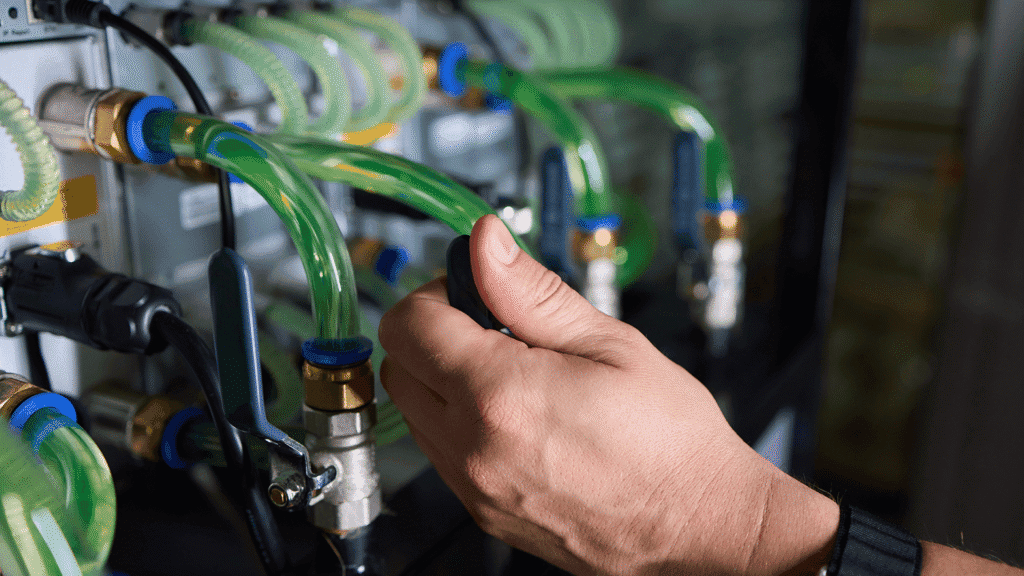
Liquid cooling, on the other hand, circulates water or specialized nonconductive fluids to absorb and dissipate heat. This technique is more direct and effective for high-density scenarios. It employs methods such as:
- Direct-to-chip cooling: where coolant is directed to specific server chips, like the Vertiv™ CoolChip CDU.
- Rear door heat exchangers: set up behind server racks to capture and release heat, exemplified by the Liebert® DCD Water-Cooled Passive Rack Door.
- Immersion cooling: involves submerging servers in a nonconductive liquid to efficiently manage heat output.
These approaches offer significantly more efficient heat management compared to traditional air cooling, making them ideal for facilities with higher density requirements.
Determining the Optimal Cooling Solution for Your Data Center
Choosing the right cooling solution depends largely on your specific rack density needs. For racks consuming less than 20kW, air cooling might suffice, as it handles lower power and heat levels efficiently. For such applications, systems like the Liebert DS Direct Expansion Cooling System are ideal, replacing hot air with cool air efficiently.
However, if your racks exceed 20kW, liquid cooling should be a strong consideration, especially beyond the 30kW threshold where air cooling struggles to manage heat effectively. A hybrid cooling strategy, integrating both air and liquid systems, is often the most effective method for high-density environments, as demonstrated by the versatile Vertiv™ CoolChip CDU.
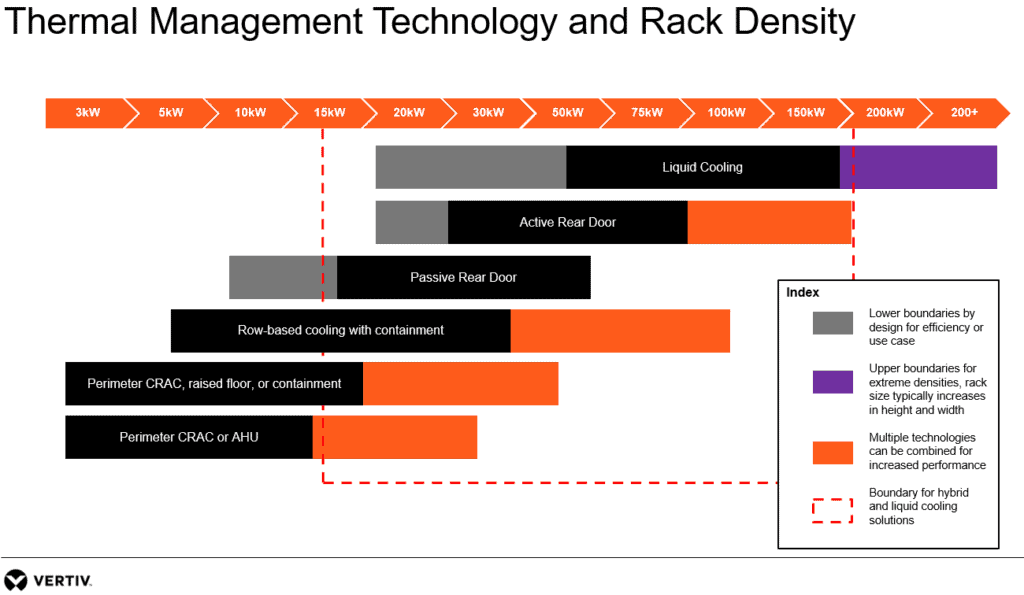
Given the rapid pace of technological advancements, adopting a flexible and energy-efficient cooling strategy can keep your facility adaptable and cost-effective. Products designed for hybrid cooling can seamlessly switch methods when necessary, ensuring optimal temperature control throughout your data center.
Keep Your Facility Running Smoothly
Maintaining an environment where your equipment can perform at its best requires more than just cooling. It encompasses a well-organized setup that is secure and up to date. With technological changes accelerating, staying informed about the latest in data center management is crucial. To receive updates on the newest cooling solutions and infrastructure practices, sign up for our newsletter. For immediate assistance or inquiries, call us at (317) 228-5800.
Frequently Asked Questions
What is liquid cooling? Liquid cooling involves using water or special fluids to remove heat from data center equipment, offering a more direct and effective cooling method for high-density environments.
How does air cooling work? Air cooling uses fans and ventilation systems to move air around equipment, ideal for less dense environments that generate less heat.
When should I consider liquid cooling? If your data center has racks exceeding 20kW, liquid cooling should be considered, with a necessity at 30kW or more due to higher heat output.
Can I use both air and liquid cooling? Yes, a hybrid approach using both systems can be highly effective for managing high-density data centers.
What are the benefits of a hybrid cooling approach? Hybrid systems provide flexibility and efficiency, allowing for optimized temperature control and energy usage, particularly in high-density settings.